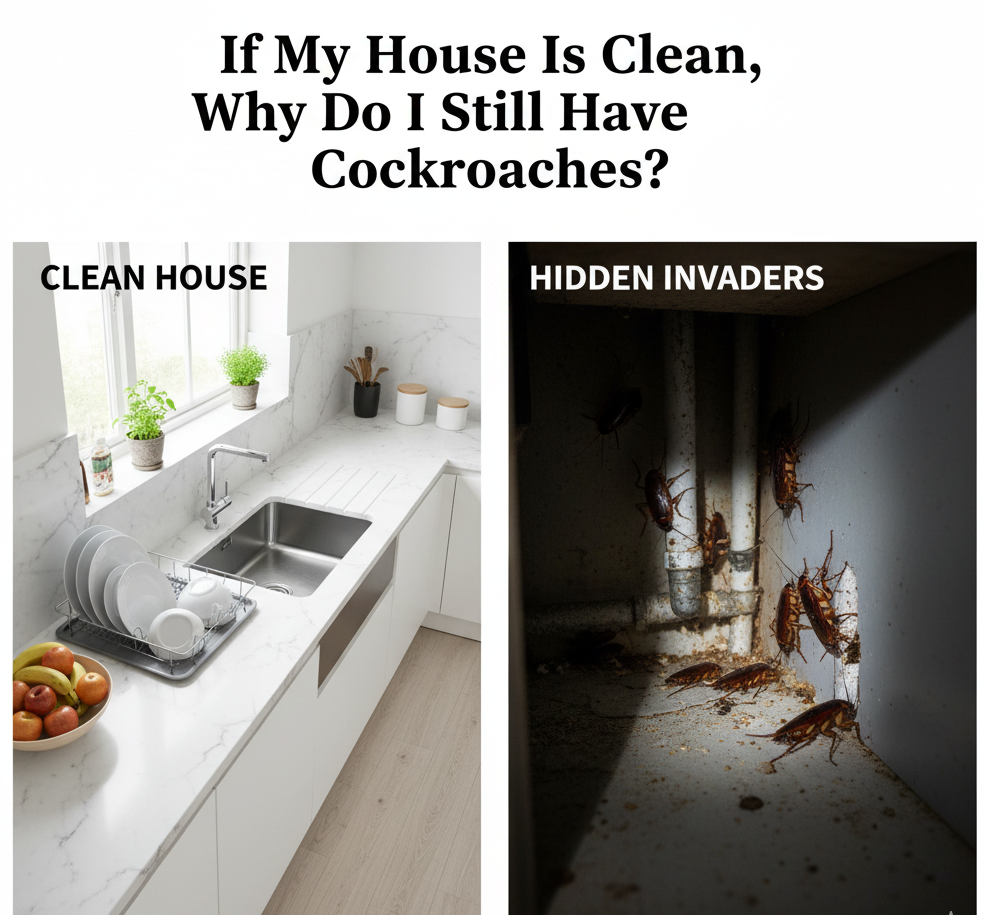
You wake up, wipe down the counters, take the trash out nightly, vacuum every corner, your home is spotless. Yet, in the dark of night, you see one scuttle across the kitchen floor. How is that possible? The truth is: being clean helps, but it does not guarantee immunity from cockroaches. These pests are masters of survival, able to exploit hidden water, shelter, and entry points that regular cleaning can’t fully eliminate.
Even in the most well-maintained homes, cockroaches can slip in undetected, find micro‑habitats with moisture, hide behind appliances or inside walls, and survive on tiny crumbs or organic residues. This article explains why roaches appear in clean homes, what hidden attractants they exploit, and how to eliminate them effectively with both prevention and professional strategies.
Quick Summary: Cockroach Problems in Clean Homes
Cockroaches are common household pests that can infest even the cleanest homes. Their survival depends more on access to moisture, shelter, and hidden food sources than on visible dirt or clutter. Common attractants include leaky pipes, condensation, tiny food crumbs in hard-to-reach places, and structural gaps that allow roaches to enter from outside or neighboring units. Because roaches are nocturnal and hide in dark, undisturbed areas, they often go unnoticed until their population grows significantly. Effective control involves a combination of moisture management, thorough cleaning, sealing entry points, and targeted pest treatments. In Fort Wayne, professional pest control services offer comprehensive inspections and treatments to eliminate cockroach infestations and prevent recurrence. Homeowners can protect their living spaces by understanding cockroach behavior, identifying common attractants, and applying preventive measures alongside expert intervention when needed.
Why Clean Homes Still Attract Cockroaches
1. Water & Moisture Are More Critical Than Food
Cockroaches can survive weeks without food, but only days without water. Even a dripping faucet, condensation under a sink, or high humidity in the basement can be enough to sustain them. Moisture in bathrooms, laundry rooms, or behind dishwashers draws them in.
Repair plumbing leaks, ventilate damp spaces, and eliminate standing water to remove what is often the strongest attractant.
2. Tiny Crumbs & Hidden Organic Matter
Cleaning countertops and sweeping floors is essential, but roaches thrive on what you can’t see. Trail crumbs under appliances, grease in vents, food debris in cracks, or the glue in cardboard boxes—all serve as food. Even pet food or spilled dry goods in the pantry can feed them.
Deep-clean hard-to-reach nooks, pull out appliances, and vacuum behind cabinets and inside cracks to deny them these invisible food sources.
3. Entry Points, Gaps & Structural Openings
No matter how clean your interior is, cockroaches can enter through microscopic gaps: cracks in the foundation, gaps around plumbing penetrations, crevices around pipes, poorly sealed vents, or torn window screens.
They even hitch rides on boxes, bags, or secondhand items. Sealing gaps, installing door sweeps, and screening vents are essential defenses.
4. They Hide in Dark, Undisturbed Places
Roaches are nocturnal and seek tight, dark, protected spaces—behind baseboards, in wall voids, under sinks, behind large appliances, inside electrical boxes, or in crawl spaces. During daylight, they stay hidden, making detection hard.
Regularly inspect behind appliances, open cabinets, check wall corners, and use traps or monitoring devices to uncover their hiding zones.
5. Neighbors & Shared Infrastructure
In multi‑unit buildings, roaches can travel through shared walls, pipes, and drains from infested neighboring units, even if your own unit is clean. Apartments, duplexes, or attached homes are especially vulnerable.
To block these paths, seal seams in walls, holes around plumbing lines, and coordinate with neighbors or building management to address infestation at the source.
6. Rapid Reproduction & Hidden Egg Cases
Cockroaches breed fast. A single female German roach can produce many eggs, and these egg cases are tucked in cracks, beneath appliances, or inside furniture. Cleaning doesn’t neutralize eggs buried deep in voids.
Professional pest control solutions often include treatments that target eggs and juvenile roaches, not just adults.
How to Eliminate Cockroaches Even in a Clean House
Step 1: Inspection & Monitoring
-
Use sticky traps or glue boards to monitor roach activity and locate hotspots.
-
Focus on the kitchen, bathroom, utility rooms, behind the refrigerator, under sinks, and in wall voids.
-
Note where roaches travel—this helps direct treatments.
Step 2: Seal Entry Points & Structural Gaps
-
Seal cracks in floors, walls, baseboards, and around utility openings with caulk or foam.
-
Install door sweeps and weather strips on exterior doors.
-
Screen vents, cover plumbing penetrations, and seal gaps around cables or pipes.
Step 3: Reduce Moisture & Fix Leaks
-
Repair dripping faucets, leaky pipes, and condensation issues.
-
Add ventilation or use dehumidifiers in damp rooms or basements.
-
Keep sinks, tubs, and drains dry, and don’t leave standing water in pet bowls overnight.
Step 4: Deep Cleaning & Removing Hidden Food
-
Move appliances, clean under them, and vacuum gaps and edges.
-
Empty trash daily, use sealed trash cans, and clean bins periodically.
-
Store all food and pet food in airtight containers.
-
Avoid storing cardboard or paper where roaches might use it for food or hiding.
Step 5: Use Effective Baits, Gel, and Insecticides
-
Apply gel baits or bait stations in cracks, under appliances, and along walls where roaches frequent.
-
Use insect growth regulators (IGRs) to disrupt reproduction.
-
Use residual insecticides in voids, baseboards, and wall cavities.
-
For severe problems, professional-grade treatments reach deeper and last longer.
Step 6: Professional Intervention
-
When DIY approaches fail or infestation is extensive, call a licensed pest control company.
-
Pros use inspections, targeted sprays, dusts, and follow-up treatments to reach eggs and hidden colonies.
-
Many offer ongoing maintenance plans and warranties to prevent comeback.
Frequently Asked Questions
1. How many cockroaches can hide in a clean home?
Even a few visible roaches may signal dozens or hundreds hiding unseen.
Egg cases often remain dormant until conditions are ideal.
The visible ones are just the tip of the infestation iceberg.
2. Can cockroaches live only on moisture without food?
Yes. In conditions without food, cockroaches can survive for weeks by feeding on organic residues.
Moisture sources like leaks or condensation become critical for their survival.
Drying out those areas can starve them over time.
3. Why do roaches hide behind appliances even in spotless kitchens?
Appliances produce warmth, vibration, and small food or grease residues.
Dark, narrow gaps behind them give perfect hiding and breeding spots.
Even very clean surfaces won’t remove those invisible attractants.
4. Are cockroaches attracted to cleanliness?
Not the cleanliness itself. They’re attracted to what remains—water, shelter, and unseen food.
A pristine home still offers hiding spaces and micro‑habitats roaches love.
Cleaning helps reduce risk—but it’s only part of the solution.
5. Can neighbors’ infestations affect my clean home?
Absolutely. Roaches migrate through shared walls, plumbing, or electrical conduits.
In attached or multi‑unit buildings, your unit may be invaded from next door.
Coordinate building-wide control to stop reinfestation cycles.
6. Do over‑the‑counter sprays work in these cases?
They may kill individual roaches but rarely reach deep eggs or hidden colonies.
Many roaches have developed resistance to common insecticides.
Professional-grade treatments penetrate deeper and last longer.
7. How long before I see results after treatment?
You may see fewer roaches in days, but full elimination takes weeks.
Egg hatching and crawling next generations reemerge gradually.
Follow-up treatments and monitoring are critical to suppress resurgence.
8. Can I prevent roaches forever in my clean home?
You can greatly reduce risk—never fully eliminate the possibility.
Continuous maintenance (sealing gaps, moisture control, baiting) is essential.
Consider periodic inspections and professional support as your safety net.
Conclusion
A clean home is absolutely helpful in reducing cockroach attraction—but it is not a guarantee against infestation. Cockroaches are opportunistic, extremely resourceful, and exploit the smallest flaws in your defenses. By combining deep cleaning, moisture control, sealing entry points, and targeted pest treatments, you can push them out for good. But when spots persist or infestations seem entrenched, it’s wise to call in professional pest control that can tackle hidden colonies and eggs with safe, effective methods.